Student Wellbeing · 2027
The State of Student Stress in 2027: Why Higher Education Is Overwhelming Students
Student stress is not only about having too much homework. It is the result of academic pressure, financial uncertainty, digital overload, work responsibilities, and the feeling that one mistake can permanently change the future.
Higher education is asking students to manage more complexity with fewer dependable margins for rest. This article will examine what is driving student stress in 2027, how that pressure shows up in daily life, and what students and institutions can do to make learning more sustainable.
1. The State of Student Stress in 2027
Student stress is a defining part of the 2027 higher-education conversation. Students are navigating academic expectations, financial pressure, work, family responsibilities, and uncertainty about the future while trying to build adult lives.
77.6% of graduate and professional students reported feeling a moderate to high level of stress within the last 30 days
“I don't really know how to explain it I can't lie. It [university] makes me depressed and I procrastinate a lot. I cried because of how stressful it was. When I'm in class I always get this weird dizzy feeling, and feel sick”
Ontario Tech University Student | Digital Media | 1st-year
2. Why Does Higher Education Feel So Overwhelming?
Students are rarely responding to one difficult class or one busy week. Overload happens when several demands stack on top of each other and there is no realistic recovery time between them.
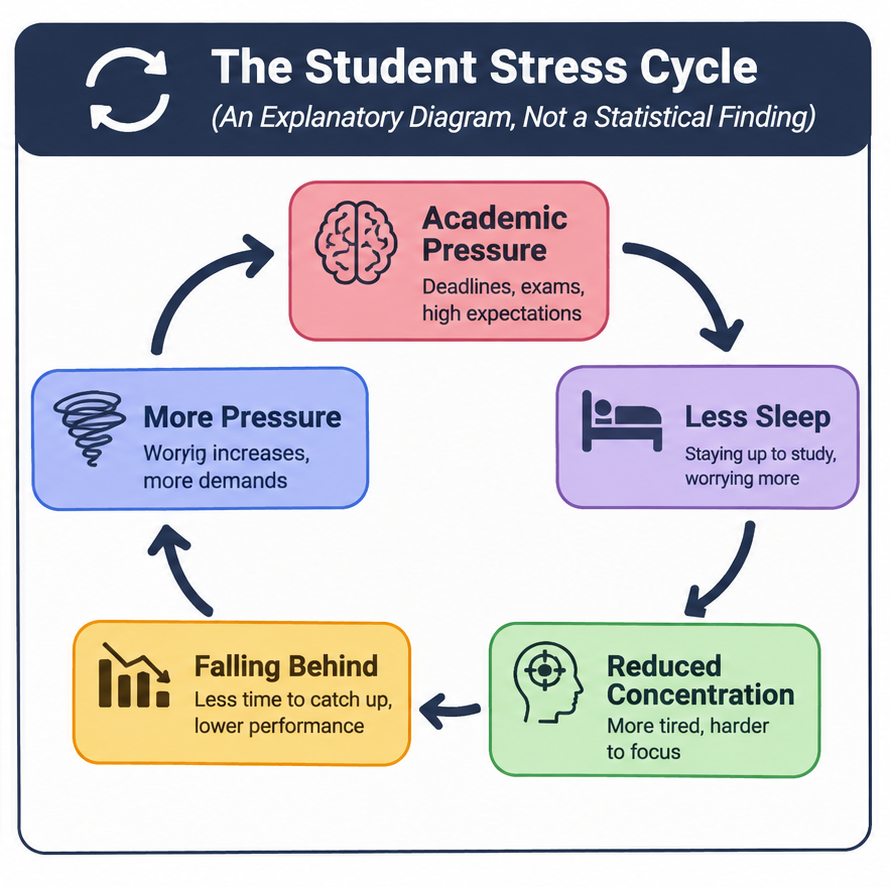
There Is Not Enough Time to Do Everything
Students have some of the busiest schedules in the world, with many juggling jobs, family responsibilities, and academic demands. It is difficult to sustain this lifestyle for long periods without feeling overwhelmed.
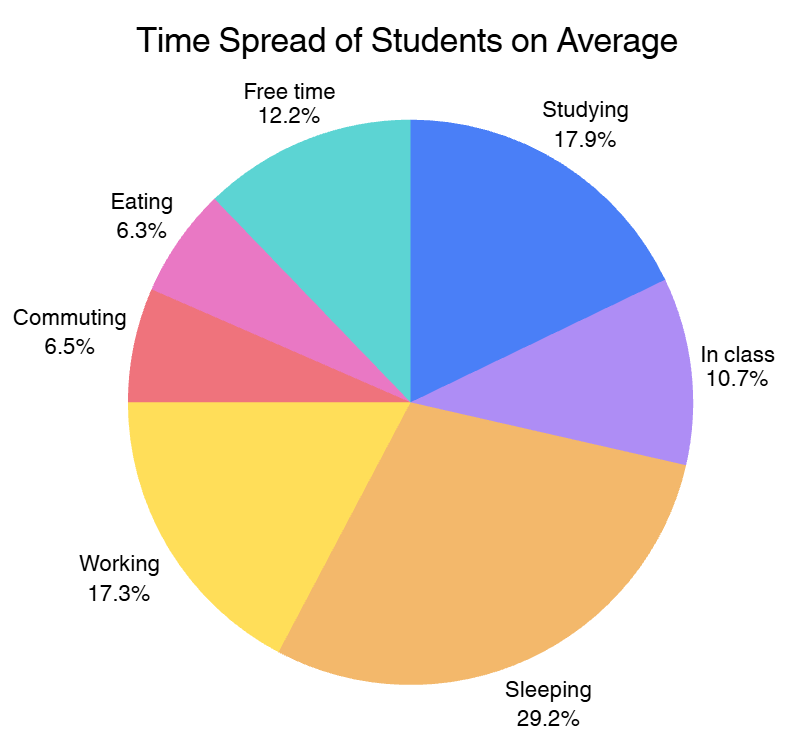
A student's weekly time budget
2-3 hours a day per credit hour spent studying.
Source: Collegiate ParentRecommended sleep for adults each night.
Source: CDCTypical weekly time spent in class.
Source: Luther CollegeTime a part-time job can take from a student's week.
Source: GlassdoorAverage round-trip college commute in one student transportation study.
Source: StudentMoveTOTime an average person spends eating each day.
Source: Statistics CanadaFinancial pressure follows students into the classroom
Tuition is only one part of the cost of attending college. Housing, food, transportation, technology, textbooks, health care, and lost work hours all affect whether a student has the time and stability to learn.
Tuition pressure across two national contexts
Average Canadian domestic undergraduate tuition.
Source: Statistics CanadaAverage Canadian international undergraduate tuition.
Source: Statistics CanadaAverage four-year in-state U.S. public tuition.
Source: Bay Atlantic UniversityAverage four-year out-of-state U.S. public tuition.
Source: Bay Atlantic UniversityThe future feels both urgent and uncertain
Students are told that education is an investment in their future, but the return can feel difficult to predict. Competitive internships, changing industries, artificial intelligence, and uncertain entry-level employment can turn every grade and decision into a high-stakes judgment about whether they are doing enough.
3. Student Stress Is Not Simply a Time-Management Problem
Time management can help, but it cannot create more hours in a day. A planner does not solve an impossible course load, an unstable housing situation, a second job, or an instructor who changes requirements without notice.
Students still benefit from clear systems: one place to collect deadlines, a weekly review, earlier starting points for large assignments, and a way to identify the next actionable step. But those tools should reduce unnecessary friction rather than shift every institutional problem onto the student.
The important distinction is that organization can reduce avoidable friction, but it cannot erase structural pressure. A clearer schedule may help a student see a conflict earlier; it cannot create affordable housing, remove a work shift, or guarantee that every course will have a manageable assessment calendar.
“I've always had trouble staying organized in school. My grades were dropping rapidly, not due to lack of understanding, but me missing assignments because of stress and bad organization. Organizing my tasks and deadlines helped with one aspect, but the stress always remains in some way or another.”
Mitchell Gibbons | Student & Founder of GatheredMind
4. What Actually Helps Students Cope
Useful support operates at several levels. Students need practical ways to see their workload clearly, but they also need policies and environments that make a manageable workload possible.
Make the workload visible
Students cannot prioritize effectively when deadlines are scattered across syllabi, announcements, emails, and memory. A single course-centered view can make conflicts visible early enough to respond.
Build recovery into academic planning
A realistic plan includes sleep, meals, travel, work shifts, appointments, and time with other people. Rest is not a reward for finishing everything; it is part of the conditions that make sustained learning possible.
Make help easier to access before crisis point
Advising, counseling, tutoring, accessibility services, financial aid, and instructor office hours should be easy to find and safe to use. Students should not have to prove that they are already failing before support becomes available.
Early support works best when it is ordinary and easy to access. Students should be able to contact advising, counseling, tutoring, accessibility services, financial aid, or an instructor before a missed deadline becomes a crisis. The goal is to create several low-pressure opportunities to ask for help, rather than one last emergency process after a student is already overwhelmed.
5. Building a Less Overwhelming Semester
Students cannot control every demand placed on them, but they can create a clearer starting point. Gather each course's deadlines, identify the weeks where major assessments collide, and break large assignments into earlier milestones. Then ask for help while there is still time for the help to matter.
The goal is not to optimize every minute. It is to make the academic load visible enough that students can make informed choices instead of reacting to one emergency after another.
Conclusion: Students Need Margin, Not More Pressure
Student stress in 2027 will not be solved by telling overwhelmed students to try harder. Higher education needs to recognize the full load students carry and design systems that give them clarity, support, and room to recover.
Students deserve systems that help them understand their workload without making them feel responsible for solving every problem alone. Gathering courses, deadlines, notes, and next steps in one place can make the semester easier to navigate, but sustainable education also requires institutions to provide realistic workloads, clear communication, and support before students reach a breaking point.
Reducing student stress is not about lowering expectations or removing challenge. It is about giving students enough clarity and margin to meet meaningful expectations without sacrificing their health to do it.
Frequently Asked Questions
Why are college students so stressed in 2027?
Students are managing overlapping academic, financial, employment, family, health, and technology demands. Stress becomes especially difficult when those demands compete for the same limited hours and students have little time or support to recover.
Is student stress only caused by academic workload?
No. Coursework is only one part of the picture. Financial pressure, paid work, housing, commuting, caregiving, health concerns, constant digital communication, and uncertainty about the future can all intensify the experience of academic overload.
What can students do when higher education feels overwhelming?
Start by gathering every course deadline and commitment into one view, then identify the next action for the most urgent item. Contact an instructor, advisor, counselor, accessibility office, or student support service early if the workload is not realistic.
What can colleges do to reduce student stress?
Colleges can coordinate major assessments, communicate requirements consistently, make support easier to access, provide flexible policies for genuine circumstances, and ask students which systems create unnecessary work. Reducing avoidable friction gives students more room to focus on learning.
Help resources
If stress feels unmanageable or you need someone to talk to, these services offer free, confidential support:
- United States: Call or text 988 to reach the 988 Suicide & Crisis Lifeline.
- Canada: Call or text 9-8-8 to reach the Suicide Crisis Helpline.
- Canada, youth support: Call 1-800-668-6868 or text 686868 for Kids Help Phone.
If you or someone else is in immediate danger, call 911 in the U.S. or 9-1-1 in Canada.
Sources
- Research.com, “50 Current Student Stress Statistics: 2027 Data, Analysis & Predictions.” Published/updated: November 5, 2026.
- CollegiateParent, “Student Study Time Matters.” Publication date: not stated.
- Centers for Disease Control and Prevention, “About Sleep.” Publication/update date: not stated.
- Luther College, “A Day in the Life of a College Student.” Published: July 10, 2019.
- Glassdoor, “How many hours is part-time? Definition and benefits.” Published: July 17, 2026.
- StudentMoveTO, 2019 Final Report. Published: 2019; exact publication date not stated.
- Statistics Canada, “How do Canadians spend their time?” Published: 2018; exact publication date not stated.
- Statistics Canada, Canadian postsecondary student tuition and living accommodation costs. Publication date: continuously updated data table; date not stated on the linked view.
- Bay Atlantic University, “The 2026 U.S. Tuition Fee Report: Trends in Public vs. Private University Costs.” Published: March 13, 2026.
- 988 Suicide & Crisis Lifeline. Publication/update date: not stated.
- Canada Suicide Crisis Helpline. Publication/update date: not stated.
- Kids Help Phone. Publication/update date: not stated.